- Compliance Office, OnFinance AI
- Posts
- Regulators Now Ask for Clause-Level Proof
Regulators Now Ask for Clause-Level Proof
Can Your Institution Produce It Today?

Anuj Srivastava
March 02, 2026
Regulatory Reality
Over the past year:
RBI consolidated decades of guidance into Master Directions.
SEBI tightened disclosure and accessibility enforcement.
Supervisory reviews began demanding clearer ownership and audit trails.
The expectation has changed.
Regulators are no longer satisfied with policies or status updates.
They now expect clear clause-level interpretation, named ownership, time-bound execution, version-controlled amendments, and evidence directly mapped to regulation.
This impacts compliance, risk, internal audit, and business control functions alike.
The question is no longer whether work was completed.
It is whether execution is traceable.
Where Execution Breaks
In many institutions, regulatory flow still looks like:

Tasks get done.
But governance depends on coordination.
When inspections begin, teams reconstruct history from inboxes, trackers, and shared drives.
Reconstruction is exposure.
Restructuring Execution with ComplianceOS
ComplianceOS acts as a regulatory execution layer : converting circulars into structured, system-governed workflows powered by coordinated AI agents.
AI Compliance Officer
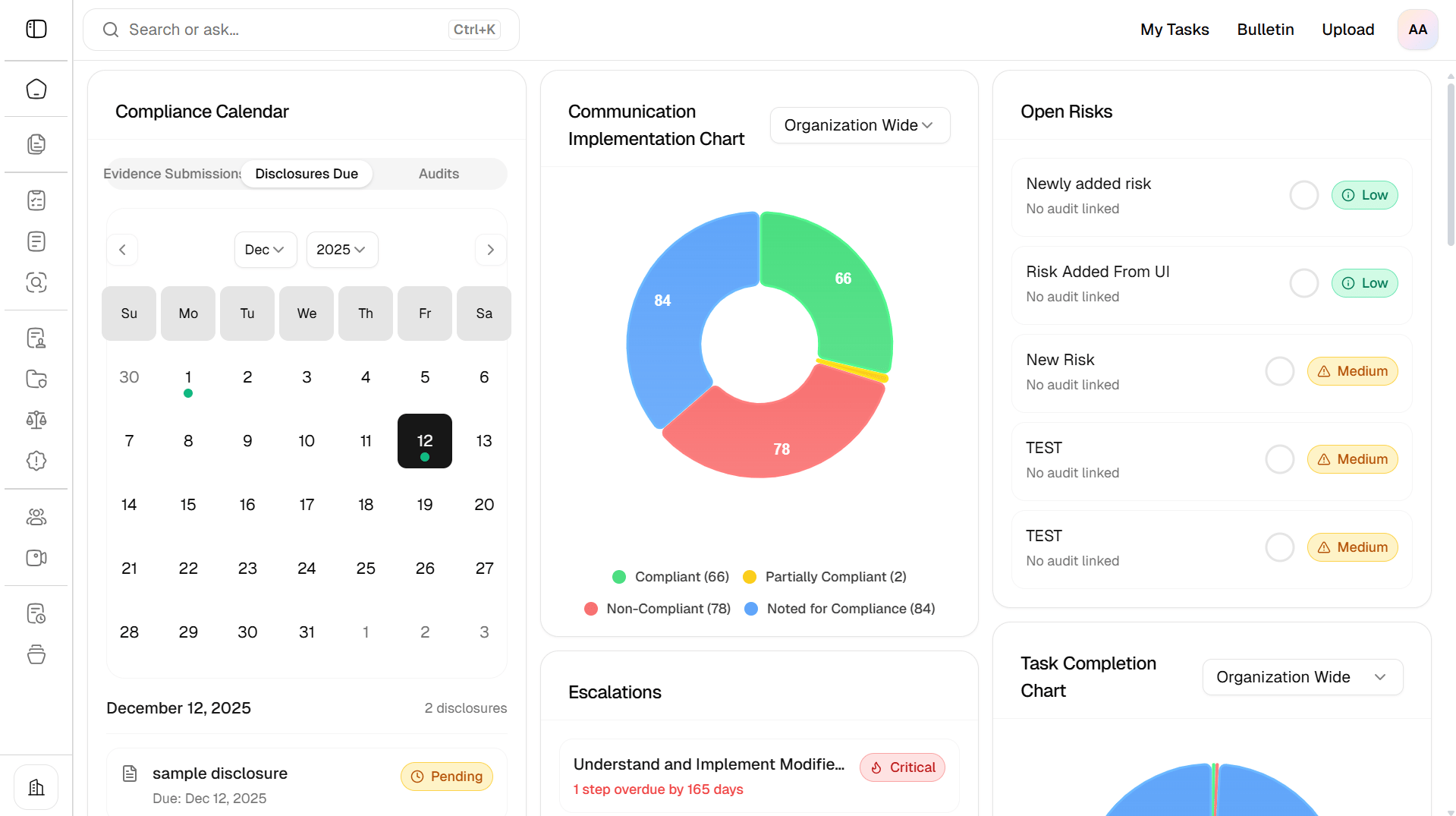
• Converts regulatory updates into clause-level requirements
• Standardizes and documents interpretation with references
AI Task Manager

• Tracks tasks by clause, owner, and deadline with escalations
• Manages recurring obligations with persistent visibility
AI Library Amendments

• Tracks additions and deletions with side-by-side comparisons
• Maintains structured regulatory timelines
AI Internal Auditor

• Links controls to evidence with full audit trails
• Flags gaps before supervisory review
AI Reporting & Evidence Vetting

• Validates evidence completeness and standardizes documentation
• Aligns submissions directly to regulatory clauses
AI Knowledge Hub

• Enables natural language, cited regulatory search
• Preserves structured knowledge across teams
The Real Question
If RBI or SEBI asks tomorrow:
“Show us how this clause was interpreted, assigned, implemented, and evidenced.”
Do your teams search for it -
or surface it in minutes?
In 2026, regulatory strength is no longer defined by policy volume.
It is defined by execution traceability.
Supervision is becoming granular and data-backed. Institutions with clause-level traceability will withstand scrutiny, others will explain gaps.
The standard has changed.
Has your execution model changed with it?
If this question is already part of your boardroom or audit discussions, the conversation is timely.
Anuj Srivastava
📧 [email protected]
📞 +91 7233089282